

Lloyd Hampson at the enlarger
I was a city boy, born in Pittsburgh, who moved to Canonsburg at age eight. You could see the Pitt thirty-six story Cathedral of Learning from the rear of our Mt. Oliver home. I told my mother that I would go to that university some day. Little did I know that this would come true. All of us kids would sit on the front door stoop and count the cars that had double tail lights. Our next-door neighbor was a streetcar conductor; they are now called drivers. Because we lived on a car line, in my mind that was a big job.
Traveling to Canonsburg on the interurban trolley (the big red streetcars) to see Grandma and Grandpa Hampson was a real treat. We transferred at the South Hills Junction from the Mt. Oliver Hill Top orange-yellow car, number 48 or 49, to the Washington streetcar that came out of the tunnel from downtown Pittsburgh. The next fork was the Washington Junction in Bethel Park. Charleroi streetcars bore left. Once, all of us fell asleep on the trolley, sleeping through Canonsburg and Washington, and waking up in rural Peters Township on the way back to Pittsburgh. I marveled at the span of real country through Upper St. Clair and Peters Township with no houses or buildings. And those trestles. Wow!
I saw chickens roaming the streets near my grandparents' North Avenue home on the South Side below the hospital. When standing at the dead-end of North Street, I would stare at a big body of water, the flood plain where ice had been made at one time. I recall seeing the flooded Monongahela River from the Liberty Bridge during the 1936 St. Patrick's Day Flood and getting the big scoop 5-cent ice cream cone at the new Isalys Oakland headquarters.
As an eight-year-old in 1936, the move to Canonsburg in Gus Livolsi's truck traveling over what is now called Old Washington Road was an adventure. It was my first trolley-free ride to Canonsburg, my dad's hometown. He returned to work with his brother, Ernie, in the family barbershop where they had learned the barber trade from their father as teenagers.
Third Ward School, 3rd through 8th grades, was an adventure for me. Principal Ross A. Mitchell, who would pop into the classrooms at any time, often talked of his Denver heritage, a mile-high piece of heaven. We never went on vacations then. My only overnight trip while in grade school was a School Safety Patrol jaunt to Washington, DC while in the seventh grade. We learned to march and were drilled like soldiers to compete in the annual National School Safety Patrol marching completion.
|  |
|
We South Side kids hiked to a fishing and swimming hole on the creek that flows under Rt. 519 located just this side of Eighty Four and near the Templeton farm. Farmer Templeton was a customer in the barbershop. I thought that he traveled a long way to get a haircut. Actually, it was probably the closest place for him.
I had my first close-up of an airplane when Kuntz landed a biplane on Hanna's Knob. We dug flint arrowheads out of the spring-plowed fields of the Johnson farm located on the hilltop at the end of Summit Ave. I had visions of Indian warfare and not the more probable hunters. In grade school, I delivered groceries in my wagon for Hoffman's Mom and Pop store located across the street. The ten cents a pop was big money for me. The forerunner of credit cards was the slip of paper that I saw my mother get at their small store.
Being a volunteer Civil Defense messenger during the early days of WW II was exciting. I was in action during daylight and night air raid drills, knocking on doors for lights out. A fifty-foot .22-rifle target range was set up in the Third Ward basement. We trained in the prone, sitting, and standing positions. The targets were hung in front of a thick steel plate angled to deflect the lead bullets into a sandbox. We took this program seriously. I could hit the target in the prone position but couldn't hit the side of a barn when sitting or standing.
In the eighth and ninth grades I helped to run Dad's two-chair barbershop. I shaved necks, combed hair and took the money, then put the haircloth on the next customer in the other chair. The only time I gave a guy a haircut was a complete buzz job, using only the electric clippers. The memory of that is still clear in my mind. I looked at Dad and he said to go ahead, starting at the nape of his head and run the clippers all the way forward, making a Mohawk first.
Prices at the time were: Haircut, $1.00; Shave, 50¢; Tonic, 25¢, and I believe the hair-end singe was 50¢. My pay was two dollars a week. It was not a tipping shop as most of the customers were laborers. A 10-cent tip was a big deal. Once in a blue moon a quarter tip would come along. Dad said that cutting my hair was like shoveling snow, there was no money in it.
|  |
|  |
|  |
|  |
|  |
Becoming a barber was not for me. However, growing up in the barbershop was a learning experience, meeting people of all ages and walks of life, and hearing many stories. Many WWII GIs on leave stopped in for a haircut and told some startling stories. One, a B-17 navigator, on a bomb run over Germany bent down to pick up a dropped pencil. A piece of flak passed through the bomber at his head level. When he sat up, he could see sky out of both holes. A drill sergeant told of having men in boot camp hold things in one hand so as to learn left from right. That reminded me of my marching days in seventh grade.
Ray Butler owned the Amoco Gas Station nearby, and John Andy's tire shop and Rev. Kemper's church were across the street. Jimmy the Shoemaker's shop (his name was James Matrogran) was just down the street. Years later, in Southern California, I met a former Goodyear engineer who had visited Andy Brothers to get the lowdown on their sawdust snow tire design. He reported back that he wanted to pursue snow tire technology. Goodyear was not interested.
One winter day in the 1930s, Uncle Ernie popped across the street to show Jimmy the Shoemaker his new cashmere wool overcoat. In doing so, he backed into the potbelly stove that heated the small shop, burning a hole in the new coat. I remember Jimmy's Rube Goldberg machine with the multitude of spinning pulleys and brushes driven by the numerous belts. I liked to take and pick up our shoes and linger to watch him work on all the different kinds of shoes on that fandangled contraption and a magic sewing machine on which he would skillfully stitch leather. Then there was the pleasant aroma of leather cement, shoe dye, and burning coal.
Veterinarian M.B. Herron told of a "highway in the sky" that was coming across the South Side and have a pier in his yard. I thought this was a wild story. The future I-79 that now covers the location of one of the Third Ward school buildings was never discussed at home or any other place as long as I lived in Canonsburg. Uncle Ernie told me in later years that one day in the shop, he wasn't feeling good at all. M.B., after hearing his tale of woe, gave him a horse pill as big as a golf ball that fixed his stomach in no time. Jim Herron Sr., in college at this time, encouraged my interest in chemistry by giving me a kit with small vials of common chemicals.
Canonsburg High School beat Charles Schulz by many years with the third floor named "Peanut Heaven." We as freshmen didn't care about climbing those stairs; we were Peanuts. That year, I opened an unlocked door to the upper floor of the gym next door to the high school, and explored what was once part of Jefferson College. The center of the room was sunken. The wall shelves were loaded with books, and several windows were broken. Bird droppings, trash, and cobwebs were everywhere. I opened one book; it was a geometry text. I put it back and got out of there real fast. I knew that I did not belong there.
I graduated from high school in the top half of my class, went into Pitt's Chemical Engineering Department, and graduated in the half that made the first half possible. It was tough work, but someone had to do it.
My brother, Harold Junior, was next in line. He learned the trade, continued to cut hair in college, and was assigned as General Pollock's barber at the First Marine Division Headquarters, thirty miles from the front line in Korea. He continued to cut hair as a side job for many years.
|  |
 |  |
 |  |
| |
The Town Park swimming pool was the center of many delightful summer days. We walked to and from the pool. Actually, we all walked everywhere. A level short-cut to the park was used from College Street just west of North Jefferson Avenue along Crosby Run. This eliminated the long walk up the North Jefferson hill.
The shallow end step area is where I learned to swim and dive by myself in 1936. I avoided Howard Stevens, the pool manager at that time. He was a stern looking guy who strutted around the pool wearing a sea captain type hat, sandals, swimsuit, and a deep tan. He was the boss. I had been told that he had coached the swimmer, Johnny Weismuller, in the Olympics. Actually, he probably never saw me and could care less about me.
Photographs of high school days
 |  |  |
|  | |
 |  |  |
Working at the pool as a basket boy on the men's side the summer of 1945 was a blast. Frank Spadaro, who taught physics to juniors, managed the pool then. He ran a tight ship; we all learned good work ethics that summer.
During my senior year in high school I worked as a stock and box boy in the A&P supermarket. At that time it was very handy for us walkers, as it was located just one block south of the barbershop. This was during the war. When I started, the only men were the store, meat, and produce managers. All the rest, from the assistant manager and down, were women.
We worked together, stocking shelves, pecking and weighing potatoes, weighing watermelons, sweeping the floors, and decorating the front windows with canned food. We wore out several heavy steel wire scoops from scooping potatoes from the concrete floor into peck-size bags. Cleaning all the windows inside and out was my job. My hours during the school year were 5 to 9, Monday through Friday, and 10 to 10 on Saturday with a lunch and dinner break for a thirty-hour workweek. I started at 75-cents an hour and got a raise to 85-cents in about six months. Twenty-five dollars a week was not bad at that time.
There were no shopping carts then and little parking space in front of the store. On Saturdays, many customers would leave their bagged groceries in the open area between the cash registers and the front window. We marked the bags for a pickup service. There was never a report of lost or stolen food.
I ate lunches at the barbershop. I liked the ham-on-rye sandwiches available at the Labor Temple, and the price was right. Dad paid for them.
"The Boys Came Marching Home" in 1946. I then started work at Bob Gibson's men's store atBill Kotyk in 1953. the same rate of pay, and worked there until starting to college in the winter of 1947. One of the first of many things learned there was to tie a Windsor necktie knot.
|  |  |
|  |  |
|  |  |
|  |  |
|  |  |
|  |  |
|  |  |
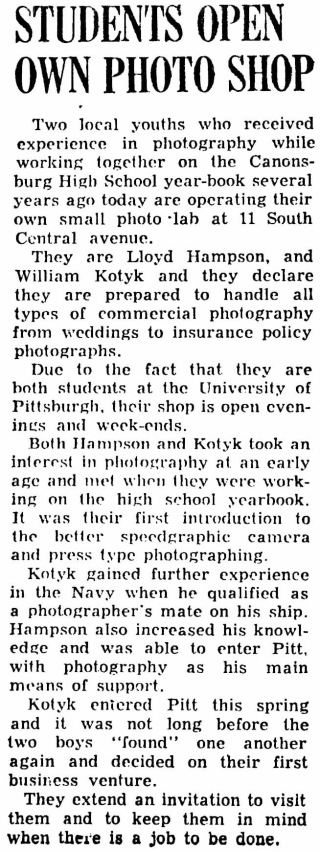
Being on the yearbook camera staff under Bill Kotyk, CHS Class of 1945 and my mentor, gave me the opportunity to leapfrog from a box camera to the large format 4x5-inch Speed Graphic camera. My goal was to study chemical engineering at Pitt. I was able to get a hardship partial scholarship which jump-started me, as my dad could not afford the costs. I needed more financing. I started to process McCorkle's Drug Store's roll film at night in my first darkroom in the small back room of the barbershop, bought a small Speed Graphic, and took my first wedding album in early 1948.
Bill Kotyk came out of the Navy as a ship's photographer. He had a tiny darkroom in his basement and also was enrolled at Pitt. We formed a partnership and opened Kotyk and Hampson, Photographers in an available spot next to the barbershop. He did the studio and darkroom layout, his older brothers did partitions, electrical, and plumbing. We all painted. Bill and I were in business from early 1948 through early 1951. We processed and sold roll film, did product, portrait, wedding, baby, and group photography.
|  |
Mary Griffith, the CHS yearbook adviser, contracted with us to process their film, make enlargements, and take group photographs. Another blanket order was from Canonsburg Hospital's professional fund raising company to take the photographs for a hand out bulletin. Our hours were 7 to 10 during the week and all day Saturday (when not at a wedding) during the school year.
Our standard wedding album contained twelve black & white 8x10 photographs that covered both the church activities and the dinner and dancing celebration. We always used two cameras and shot at least two dozen pictures. Our first album was priced at $40. The price at the end of 1950 was $60. Learning to polka at the wedding celebrations and eating Polish and Italian food was a bonus. This, plus the food served at Mazza's Royal Grill and Bardos' Candy Shop were Canonsburg at its greatest.
 |  |  |
 |  |  |
| ||
My family moved to Boon Terrace after I graduated from high school. Living on the top end of Strabane Avenue added a new dimension to getting to the photo shop, let alone to college in Oakland. Praise carpools, safe hitch hiking, I.C. Patsch & Sons' buses, Greyhound, Pittsburgh Railways Company's interurban line, and two WW2 veterans in Boon Terrace who were starting in Pitt's engineering school.
|  |
 | |
|  |
 |
Bill Kotyk and I closed shop shortly after graduating to pursue separate careers. We remarked in later years that photographic technology took off in the 50s, after we left the business. Single lens reflex 35mm and instant cameras, color print film, faster processing chemistry and light sensitive paper, and computer-aided-design optical systems produced a huge market that we missed.
 |  |
| |
The technology since then has continued at a rapid pace. Our small volume of black & white roll film processing is way overshadowed by today's volume. This summer, the 1-Hour Photoshop at the supermarket, where I get my 35 mm film processed, did a record 4,000 4x6 prints in a 10-hour shift. Their normal day's production is about 3,600 prints. Kodak and others have just introduced black & white film that can be developed and printed in mini-labs on color paper.
Digital photography, a spin-off of the space program, is to the point now that virtually every image printed commercially is being digitized at some point in the process. Many personal, editorial, and artistic images are also being digitized in order to make them easier to clean up, manipulate, and print. Just a scanner or digital camera, a computer with imaging software on it, and an output device like a printer are needed.
Bill would agree with me that this is the greatest photographic tool to date. However, the actual equipment being used has very little effect on the fundamental ability to make good photographs. Good photography, whether conventional or digital, depends more on upon a photographer's ability to visualize than the equipment being used.


 PG STORE

